At the end of a Unit of Inquiry, it is quite possible to have a large collection of work and still be unsure what students have understood. There are finished tasks, attractive diagrams, and folders that will barely close. Everything looks productive.
A teacher once put the problem to me very plainly: “It looked impressive, but I couldn't see how they'd changed as thinkers.” That is a useful challenge for anyone planning assessment. What does the work actually tell us?
I don't think the answer is to dismiss worksheets or final products. A short written task can reveal a misconception very efficiently, and a finished piece can show what a student can do independently. The difficulty comes when we treat completion as sufficient evidence of understanding. We need to know something about the thinking that produced the work, too.
Documenting a change in thinking
Pedagogical documentation helps us attend to that process. A photograph, draft, or brief note from a conversation can capture something worth returning to. Its value depends on the question we are investigating. A photograph of children gathered around a table tells us very little on its own. An accompanying explanation of what they were debating, and how their ideas developed, makes it more useful.
Project Zero's thinking routine I Used to Think... Now I Think... offers a straightforward way to help students examine a change in their thinking. The important part is asking them to explain the change. What did they encounter that challenged their first idea? Which part of their understanding is still uncertain? The routine opens a conversation; the sentence stems alone don't tell us how secure the learning is.[1]
In a Grade 5 inquiry into systems, students brought together process photographs, drafts, and reflections for a Showcase of Growth. One student wrote, “At first, I thought the government was the only system. Now I see systems everywhere — even in my soccer team.” That reflection gave us something specific to explore. We could ask which parts of the team formed a system and how those parts depended on each other.
The display mattered because students could use it to explain their learning. Families could see where ideas had begun and what had changed, rather than having to infer understanding from a polished final piece.
Selecting what is useful
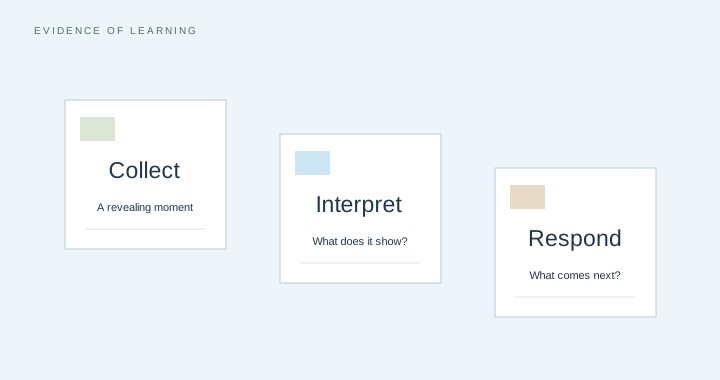
There is a workload question here, too. We can spend so much time recording learning that we have less time to respond to it. A digital portfolio full of uploads is another collection unless somebody selects, interprets, and uses the material. I would rather keep a few revealing examples than document every activity.
For me, a useful test is whether the evidence helps us decide what to do next. It might show that a student needs another example, that a group is ready for a harder question, or that an explanation needs revisiting. Documentation earns its place when it helps teachers and students understand the learning well enough to act on it.
References
Written by Tim Van Der Merwe.
Continue the conversation ↗