A leadership title gives someone authority to make decisions. It doesn't tell us whether people will trust those decisions or commit themselves to carrying them out. That depends on what staff come to believe about the person making them.
For me, this is where legitimacy becomes useful as an idea. A leader needs to be credible in the eyes of the people they lead. Staff need reasons to believe that a decision is informed, fair, and concerned with the work of the school. Those reasons accumulate through experience.
Trust is built in the small decisions
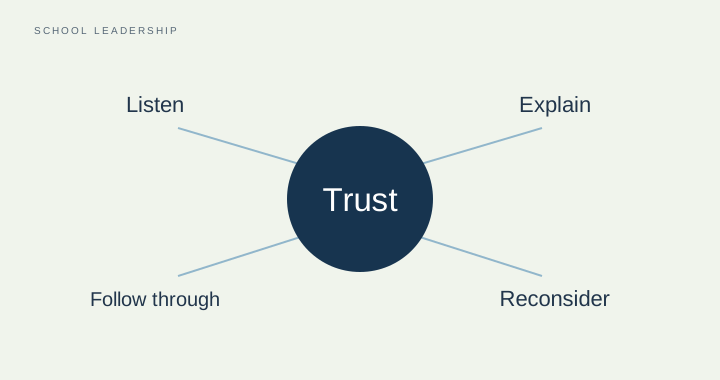
Small decisions count. Does the leader follow through? Do they listen when someone raises a problem? Can they explain why a priority has changed? If they ask teachers to reduce unnecessary work, do their own decisions help make that possible? Staff are well placed to notice a gap between a stated value and what happens in practice.
Bryk and Schneider's work on relational trust gives this concern a research foundation. In their study of school reform in Chicago, stronger trust across a school community was associated with greater willingness to try new practices and work together on improvement. Trust helped create conditions in which people could take the risks involved in changing their work. It wasn't a guarantee that any particular initiative would succeed.[1]
Make influence and responsibility real
Listening is part of building that trust, but consultation can become a performance if the important decisions have already been made. People need to know what they can influence. A leader can be clear that some requirements are fixed while inviting staff to shape how the school responds. That is more respectful than offering choices that aren't really available.
Sharing responsibility also requires support. Asking teachers to lead an initiative without time, resources, or authority can simply give them more work. If we want staff to exercise judgement, we have to consider what they need and which decisions we are prepared to let them make. We also have to accept that their approach may differ from the one we would have chosen.
School culture complicates all of this. A proposal arrives in a community with its own history, including earlier changes that may have disappointed people. Resistance can tell a leader something worth understanding. It may reflect workload, a practical problem, or a concern that has not been addressed. Treating it as a failure of attitude is an easy way to miss useful information.
Listening to the wider community
The wider community deserves the same care. Families bring knowledge about their children and expectations about the school. Partnerships take time, clear responsibilities, and a willingness to hear things that may be inconvenient. Inviting people into a conversation matters more when their contribution can affect what follows.
None of this removes the need for difficult decisions. Leaders sometimes have to act without agreement, and trust can be tested precisely at those moments. I would look for someone who can explain the decision, acknowledge its costs, and return to it if the evidence changes. That seems a firmer basis for legitimacy than expecting people to accept a decision because of the title attached to it.
References
Written by Tim Van Der Merwe.
Continue the conversation ↗